Guest lecture in «Sound in Space» Workshop

Next Wednesday March 17, at the National Academy of the Arts (Bergen, Norway), under the title «Art, sound and city: a context for Urban site-specific Sound Installation» I will give a lecture on my PhD research. I will provide with some examples and talk about some theoretical concerns in relationship with the topics that will be worked in the workshop «Sound in Space», organised by KhiB and BEK from 10 till 19 March and conducted by Trond Lossius and Nils Peters.

Through the artworks of contemporary artists working with sound in the city, we will address the issue of Space and the City to analyse the emergence of other spatial dimensions in the urban context, as the social, anthropological and political ones are. In order to put in context these concerns into the discourses of Contemporary Art, we will turn our attention to some previous examples and theories of the 50’s and 60’s that will give us the clues to interpret Urban Sound Installation at the present moment.

Venue: BEK – Bergen Senter For Elektronisk Kunst | C. Sundts gate 55 | Bergen, Norway
When: March 17, 13.00 p.m.

—-
The SOUND AND SPACE workshop, tailored to sound and media artists, sound designers, musicians and composers, will investigate the expressive potential offered by spatialisation (virtual positioning of sound in space) and will allow participants to gain practical and artistic experience with state of the art solutions for work on spatial sound in artistic contexts. The workshop will start with a practical introduction to work on spatialisation, with a particular emphasis on the use of ViMiC (Virtual Microphone Control), as well as tools for spatialisation developed within the framework of Jamoma. After an initial introduction to use of the software, the rest of the workshop will be spent on investigations into artistic possibilities offered by the software for sound art, media installations, music and sonic scenography. The project ends with a public «work in progress» exhibition presentation of the works done by participants.

UCM – EEA Munch Extraordinary Chair

Gracias a una beca de movilidad NILS para investigadores y artistas, me trasladaré, a partir de enero de 2010 y durante tres meses, a Bergen (Noruega) para trabajar en la National Academy of the Arts (KhiB) y el Bergen Center for Electronic Arts (BEK).


Thanks to a grant of the NILS mobility project for researchers and artists, I will move my residency, from January 2010 and for 3 months, to Bergen (Norway) to continue my research at the National Academy of the Arts (KhiB) and the Center for Electronic Arts of Bergen (BEK)

¿Arte Sonoro? Conferencia / In-Sonora V

Dentro del transcurso del V festival de arte sonoro e interactivo In-Sonora, el próximo sábado 28 de noviembre, a las 19h. tendrá lugar en la Escuela de Música Creativa un encuentro donde José Luis Espejo, Alfredo Aracil y yo expondremos varios acercamientos al sonido.

En mi caso, bajo el título ¿Arte sonoro?, mi charla pretende cuestionar la validez del término de esta disciplina que, como queda demostrado por la heterogeneidad de propuestas que se encuadran en ella, puede abarcar casi cualquier cosa ya sea musical, artística, social, política, etc. ¿Es el arte sonoro una disciplina en sí misma, con cierta autonomía del resto? o ¿somos nosotros quienes hacemos del arte sonoro un modelo ajustado a nuestras necesidades? Estas y otras cuestiones las abordaremos el próximo sábado.

Lugar: Escuela de Música Creativa | C/ La Palma, 35  (Madrid) | Metro Tribunal

Sonido, espacio y configuración de la memoria en los procesos artísticos contemporáneos

El próximo Jueves 19 de noviembre a las 16h. como parte del simposio «Memoria, Narración y Justicia. Los usos políticos de la memoria» organizado por el Instituto de Filosofía del CSIC tiene lugar la mesa redonda “Lugares y paisajes de la memoria” coordinada por la investigadora del CSIC Ana María Rabe en la que participaré junto a otros investigadores presentando una aproximación al tema desde el ámbito de mi investigación artística sobre instalaciones sonoras realizadas en espacios públicos.

El simposio, que se celebra entre los días 18 y 20 de noviembre, reúne interesantes propuestas. Un programa detallado de las tres jornadas de trabajo puede consultarse aquí

Lugar: SALA 0E18 “Menéndez Pidal”, del CCHS/CSIC, C/ Albasanz 26-28, Madrid

Resumen de mi intervención

Las formas de evocar la memoria en el arte han cambiado sustancialmente con la incorporación de las nuevas tecnologías en los procesos de creación contemporánea. El sonido y los espacios específicos en los que se realizan las intervenciones artísticas cobran un protagonismo en esta transición, e imprimen una diversidad de acercamientos posibles al tema de la memoria por su forma de hacer alusión a cuestiones como la presencia, el paso del tiempo, el acontecimiento histórico y presente o la rememoración de las voces y los espacios silenciados.

Sigue leyendo «Sonido, espacio y configuración de la memoria en los procesos artísticos contemporáneos»

Encuentro con jóvenes investigadores

SemanaCiencia Martes 10 de noviembre.  9.30 h.
Lugar:
Residencia de Estudiantes
C/ Pinar 21-23 | Madrid

En el marco de la Semana de la Ciencia. Presentación de proyectos de investigación. Participan:

María Andueza | Ángel Alcalde | Carmen Barba | Maria Luciana Cadahia | Pamela Colombo | Pedro Luis Críez | María Escudero | María Ángeles Galindo | Sonsoles Hernández | Juan José López | José Ramón Marcaida | Antonio Jesús Pinto | Roberto Rubio | Abraham Sánchez | Daniel Silvo

logo_pdf Descargar póster María Andueza / Download poster María Andueza

Maryanne Amacher (1938-2009)

La compositora americana y artista de instalaciones sonoras Maryanne Amacher falleció el pasado 22 de octubre en Rhinebeck, N.Y. Con su marcha, el 2009 se lleva consigo a otra de las grandes figuras de la creación y la composición contemporáneas.  Amacher, poco conocida dentro de nuestras fronteras, contaba sin embargo con una dilatada trayectoria profesional. La que aquí escribe nunca ha experimentado en vivo ninguna de sus obras, sin embargo leyendo sobre ellas puede uno concluir que llevaba a los oyentes al extremo de la audición, generando una escucha límite con sus conciertos o performance (ya que a Maryanne Amacher le gustaba dejarse ver con su peculiar aspecto).  Amacher se alejó, como ya lo hicieran otros, de los escenarios convencionales de la música. Alumna de Karlheinz Stockhausen, aprendió y desarrolló una preocupación por el espacio del sonido. En algunas de sus instalaciones trabajó con el sonido inducido que se transmite, al menos en parte, por la estructura arquitectónica de los espacios intervenidos; en 1967 recurrió a la retransmisión radiofónica en su proyecto City Links, que duró más de diez años y consistió fundamentalmente en la deslocalización geográfica del sonido. Así durante tres años, por ejemplo, escuchó en vivo en su estudio la retransmisión del muelle número 6 del puerto de Boston (Pier 6 Boston Harbor). No es fácil encontrar información de esta artista aunque parece que con su muerte llega la resistencia a la desaparición y el olvido. Recientemente se ha puesto en marcha el Amacher Archive Project que promete darnos más información de su obra. En este enlace http://www.ecstaticpeace.com/daytrip/ se pueden ver algunos vídeos de su colaboración con Thurston Moore miembro de Sonic Youth.

Site-specific Sound Installations in the Urban Environment

Site-Specific Sound Installations in the Urban Environment
María Andueza

In: Motje Wolf (Ed.) Proceedings of Sound, Sight, Space and Play 2009 | Postgraduate Symposium for the Creative Sonic Arts | De Montfort University Leicester, United Kingdom, 6-8 May 2009 | http://www.mti.dmu.ac.uk/events-conferences/sssp2009

Abstract

This paper examines urban site-specific sound installations, as an artistic expression that integrates other disciplines such as sociology and urbanism in the practice and theory of art. It also explores the impact these soundworks produce not only on the physical city but also on the role that citizens play in it. I propose a critical and theoretical approach to this field of sonic arts from the main topics that along time artists have been concerned for in their artwork: on the one hand the relationship between the artwork and the spectator, and on the other the analysis and reasoning of the space through the work of art. In considering site-specific sound installation from these two starting points, the echoes of the previous non-sonorous artistic tradition, especially that closest to its advent in the mid-sixties are noticeable. For this reason, together to their sonorous specificity, other arguments, such as their sociological, urban and phenomenological implications, are rather suggested in this discussion to come up to the expanded and renewed concept of total art integrated within the dynamics of the city.

logo_pdf

Descargar archivo PDF / Download PDF

Algarabía. Estudio I

English below

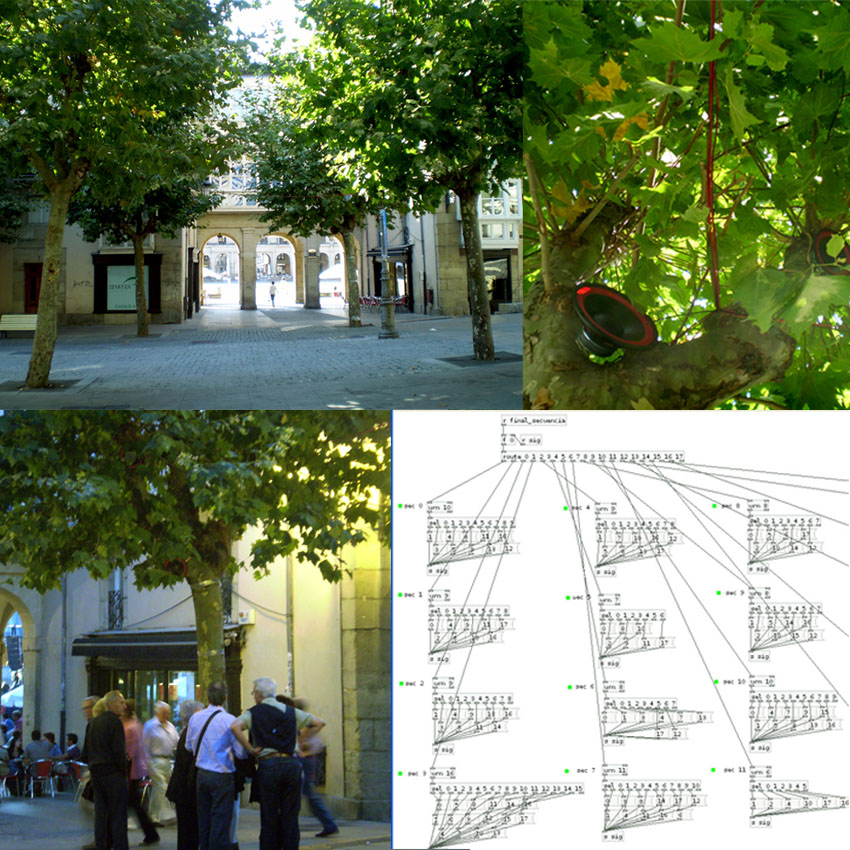
La delgada línea que separa lo íntimo de lo que es público toma el protagonismo en Algarabía, una obra en proceso que muestra la manera espontánea de revelarse espacios inmateriales de la ciudad. El valor de lo efímero y perecedero, interpretado a través de una propuesta sonora reconocible para cualquier ciudadano, sugiere la creación de espacios urbanos no físicos ni materiales.


Algarabía formará parte del festival Luna KREA 09 que tiene lugar la tarde-noche del viernes 11 de septiembre de 2009 en la ciudad de Vitoria-Gasteiz. La instalación estará ubicada en la calle peatonal Lehendakari Aguirre, desde donde se accede, por una de sus arcadas, a la plaza mayor de Vitoria-Gasteiz.

Se trata de una instalación sonora de ocho canales que reproduce el fenómeno natural, y muy ruidoso, que provocan los gorriones en zonas urbanas pobladas con árboles. Cuando el sol comienza a caer, centenares de gorriones se reúnen en la copa de estos árboles para proceder, tras una escandalosa despedida, al descanso. Lo que en un principio es el tímido trinar de unos cuantos pájaros, se convierte en un corto espacio de tiempo, en un alboroto de gorjeos donde sólo queda escuchar el sonido de la concurrencia. Dicho fenómeno está en consonancia con el fenómeno sonoro colectivo que producimos los humanos cuando nos congregamos en un gran número en un espacio determinado. Algarabía a través de la fragmentación de la voz humana, no sólo reproduce el fenómeno natural sino que, a su vez, gracias a la espacialización y a la experimentación de los ciudadanos, genera en su proceso el espacio inmaterial de su propia existencia.

Escucha una muestra sonora del sonido de la instalación descontextualizado de su lugar específico (se recomienda la audición con auriculares) / Listen a fragment of the sound of the installation – out of its specific context – (it is recommended the use of headphones)

Agradecimientos: V. Alonso, F. Andueza, J. Andueza, I. Andueza, C. Barba, A. Bernal, J. Cárdenas, P. Colombo, P.L. Críez, D. Cucalón, D. de las Heras, M. Galindo, A. Gil-Fournier, M.P. Olmedo, F. Olmedo, M. Ramos, R. Rubio, G. Vidal y otras voces anónimas.

Fecha y ubicación: 11 – Septiembre – 2009 |  Festival Luna KREA | Vitoria-Gasteiz | C/ Lehendakari Aguirre | Hora: 19:00

English version: Algarabía (Gabble) was an outdoor sound installation for 8 channels created specifically for a Public Art festival in Vitoria (Spain). The piece was installed in four trees of a pedestrian street in the city center. The work reproduced with human voices a natural phenomenon, created by the birds in the moment previous to sleep. A phenomenon that is also perceivable in our everyday context. This process that consists basically in the trills of the birds that augment gradually when they hear each other is very typical in the bars with the human voice. At the beginning we can hear the single trill or the single voice, but gradually when more trills and voices, are sounding together we can not discern the single trill or the single voice but a mass of sound in which some fragments of trills or voices can be heard. In Algarabía (Gabble), 3000 syllables of different voices reproduced this phenomenon, achieving the jabber of fragmented human voices spatialized in the crowns of the four trees. The piece was real time produced so the result was continually changing.

Mesa redonda – Espacio y Arte Sonoro

English below

Entre el 24 y el 26 de Junio de 2009 tendrá lugar el III Encuentro Iberoamericano de Paisajes Sonoros. Las jornadas están organizadas por Jose Luis Carles en colaboración con la UAM, la Residencia de Estudiantes, el Centro Virtual Cervantes y el Ministerio de Ciencia e Innovación. Entre los participantes, el encuentro contará con la presencia de José Iges, Concha Jerez, Cristina Palmese, Ricardo Atienza y Adolfo Núñez.

El viernes 26 de Junio, a las 12.30 h. tendrá lugar la mesa redonda «Espacio y Sonido en el Arte sonoro» en la que participaremos José Iges, Concha Jerez, Luis Barrié, Ricardo Atienza y yo misma.

Mi presentación Espacio público y arte sonoro estará dirigida a analizar, a través de la instalación sonora en la ciudad, la formación del espacio social urbano. En esta ocasión presentaré obras con las que podremos abordar temas como la denuncia política, las relaciones humanas o la memoria histórica, tratados todos ellos desde el desarrollo sonoro en el contexto de la ciudad.

Para ver el programa completo del III Encuentro Iberoamericano de Paisajes Sonoros pinchar aquí

Lugar: Residencia de Estudiantes. C/ Pinar, 21-23 (Madrid) | Tfno. 91.563.64.11

// English version //

Next 24-26th June will be held at the Residencia de Estudiantes the 3rd Iberoamerican workshop and conference on Soundscape. The conference is organized by José Luis Carles in collaboration with Residencia de Estudiantes, UAM, Centro Virtual Cervantes and the Science and Innovation Ministry. Among the participants on the Conference and workshops will be José Iges, Concha Jerez, Cristina Palmese, Adolfo Nuñez and Ricardo Atienza

Friday, June 26th, at 12:30 p.m. I’ll be participating together to Jose Iges, Concha Jerez, Luis Barrios and Ricardo Atienza in the round table «Space and Sound Art».

My presentation “Sound Art and Public Space” is going to analyse, through sound installations conceived for the city, the development of urban social space. In this occasion I’m going to present works that can address the public opinion, human relationships or history, treated all of them from the sound insertion in the context of the city.

To view the complete program of the 3rd Iberoamerican workshop and conference on Soundscape click here

Place: Residencia de Estudiantes. C/Pinar, 21-23 (Madrid) SPAIN